Thank you to Olivia for this one.
Showing posts with label Larkin. Show all posts
Showing posts with label Larkin. Show all posts
Sunday, 26 April 2015

Friday, 24 April 2015
Saturday, 7 March 2015
Larkin poems about beliefs.
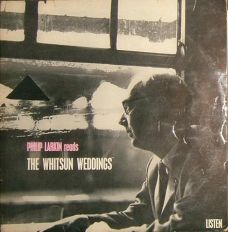
Here are my group's useful revision presentations about the short philosophical poems in "The Whitsun Weddings" with some interesting links to an Abse poem in the volume "Welsh Retrospectives":
Tuesday, 27 January 2015
Welcome New Bloggers!
Welcome to the new generation of bloggers recording their thoughts and reactions to Larkin's poems. I hope you will read each others' posts and comment on them if you find them useful or have anything you want to add. You might even want to offer alternative opinions and interpretations on theirs. After all this is exaclty what AO3(ii) is all about - being aware of other readers' interpretations!
First - here is the link to the 1960s programme about Larkin "Down Cemetery Road" which you have doodled about...
Next is a documentary made more recently about Larkin which offers a contemporary perspective on Larkin after his death...
First - here is the link to the 1960s programme about Larkin "Down Cemetery Road" which you have doodled about...
and finally, here are some videos of Larkin reading his own poems. You might want to add these to your own posts:
An Arundel Tomb:
Afternoons
For Sydney Bechet
The Whitsun Weddings
Wednesday, 5 February 2014
Characteristics of Larkin so far...

After reading 13 of Larkin's poems in the volume, here is a summary of what we think so far. I've added my own ideas to yours. Please continue your own summary so far on your own blog:
Subject Matter
Contemporary
(60s) life – observations on mundane details of life and people-watching
Place - rooted in real locations which have significance for Larkin
Time
– Time slipping away. Element of regret
about life changing decisions – points at which life could change forever.
Youth - full of promise, hope and expectation for greatness
Expectations - can lead to disappointments, unfulfilment - looking back with perspective
Age
– he voices unsayable hatred of old age – perhaps shrouding fear of own ageing.
Death - inevitable, not to be feared
Change/Mutability
– England
Family - relationships, loss, love - parents seen from middle-age
Love, Marriage and/or Sex
– ability to see potential for greatness in marital union, but also base desire for sexual instinct to reproduce, difficulty of ultimate commitment - marriage a trap?
Life Choices - Fate
or free will? – are lives products of our existential choices or determined by
destiny, genes, our upbringing etc? Inevitability of age, regret etc.
Isolation - being an outsider, not conforming to the "norm"
Doubt - comparing self with others - who made the better life choices?
Hope
– that out of something ritualistic or stripped of meaning or seemingly
negative something good can come
Music/creative idols - passion for jazz - an escape, a "truth" in music. Timeless - triggers memories of younger selves

Attitudes expressed
Relationships,
marriage love – against them personally (?) - they hold you back/tie you down? but aware that they do suit some
people
Being
alone – not a bad thing, but offers possibilities for greater clarity
Accept life decisions made - no point in regretting
Other
people – rather negative and disparaging about their ignorance and lack of
vision
Dislikes
artificiality and falsity or show and pretence (modern life again) - a realist?
Against
organised religion – cynical.
Hope
expressed at end of poems – assertion of what’s good out of something which
initially seems negative/mundane to him
Philosophical - big ideas about human existence, reflective
Melancholy, pessimism (?) - glass half-empty?
Atheist/agnostic ? - but knowledgeable about faith and belief in others
Speaker
First
person (a persona not necessarily Larkin – make this clear)
An
onlooker – isolated from what he observes but able to see it more clearly
Disparaging
about those with “normal” lives
A
somewhat superior tone, sometimes angry or bitter (?)
 Sometimes compassionate
though and aware that other interpretations than his own have validity - he may be wrong
Sometimes compassionate
though and aware that other interpretations than his own have validity - he may be wrong
Reflective - introvert - nostalgic?
Structure of
poems
Initially:
Detailed concrete observation of everyday experience in often simpler language
Then:
Movement towards less concrete more abstract and metaphoric observations with
more overt judgements about what observing – more complex language
Finally:
A more expansive philosophical observation on some part of human existence –
usually
paradoxical in nature. An
epiphany at the end – a sudden realisation of
a grand thought. Often ambiguous language or open-ended.
Rhyme, rhythm , structure varied
from poem to poem – to suit individual poem’s ideas
Shows
flexibility and virtuosity of poet
 Style
Style
Vocabulary
– wide and varied, carefully chosen for connotations but sometimes reproduces
colloquial, contemporary expressions.
Not specialist or archaic except for effect. Can be very erudite and learned - huge scope of cultural allusion/reference
Technically
very sophisticated:
Use
of sound effects for emphasis (of eg speed, heat): alliteration, assonance
Use
of connotative language
Use
of cumulative listing devices to suggest weariness,
Use
of compound adjective to collide ideas in efficient way
Use
of rhetorical cadences (eg groups of threes) to reach crescendo or diminuendo
Sparing
use of imagery when dealing with the abstract ideas reached by end of poem –
metaphor, simile, personification, anthropomorphization
Sophisticated
rhyming structures, but use of enjambment and caesura often hides them,
deflecting monotony and communicating rhythms of everyday speech
Use
of the conceit – metaphysical: a startling or unusual comparison which takes us
onto a completely different level of ideas
Use
of paradox and rhetorical devices which suggest paradox (oxymoron)
Use
of bathos – anticlimax to suggest mundanity or humour or condescension
Use
of pathetic fallacy – heat to suggest stifling repetition
Tuesday, 4 February 2014
Mr Bleaney
"How we live measures our own nature"

- To what extent do you think this is true?
- How much do you think you can tell about someone from the kind of place they live in and the things they have in their home?
- What would your room tell us about you?
Here's an audio of Philip Larkin reading the poem himself
Link to hypertext version of poem
Once you have studied the poem, consider what other critics have said about his poems:
Love and Death in Hull 2003
There is a more recent documentary about Larkin's life called Love and Death in Hull. it was made after Larkin's death in 2003, so is a good overview of all his work.
Larkin on film
You might like to see this famous documentary, Monitor, featuring Philip Larkin which was made in 1964. In it, the poet is interviewed by John Betjeman (the poet laureate of the day) in a series of locations in and around Hull, and Wikipedia suggests the following:
(the programme) allowed Larkin to play a significant part in the creation of his own public persona; one he would prefer his readers to imagine.
It is in three parts on You Tube and you can play them one after the other.
(the programme) allowed Larkin to play a significant part in the creation of his own public persona; one he would prefer his readers to imagine.
It is in three parts on You Tube and you can play them one after the other.
Subscribe to:
Posts (Atom)